Description
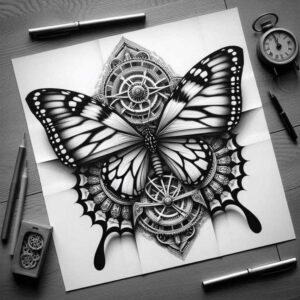
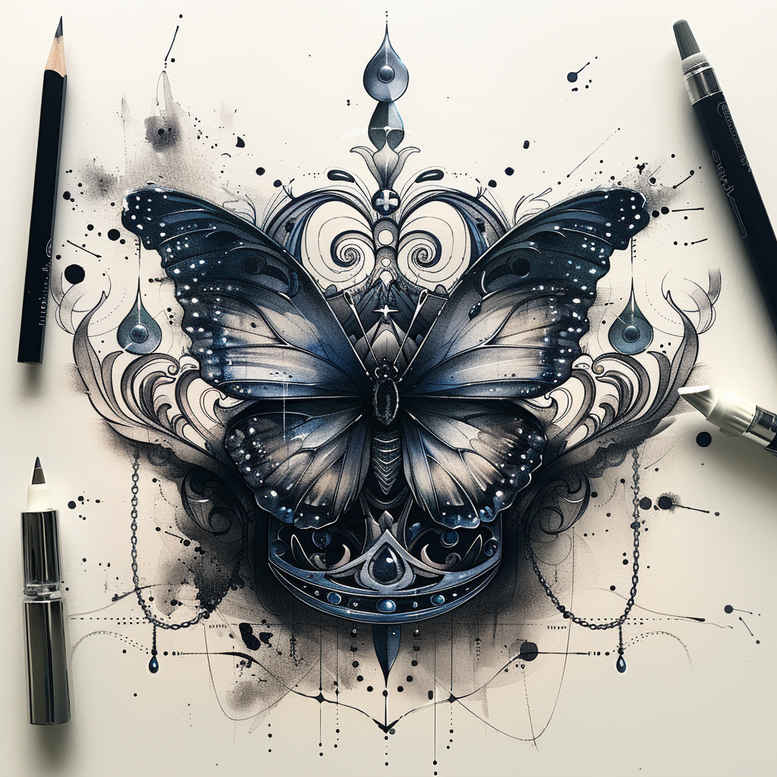
AI-generated tattoo project presented here explores a blue and black butterfly rendered in fine line tattoo technique, set against an architectural matrix of ornamental geometry. The central butterfly motif is defined by precise linework, soft gradient shading, and deliberate stippling to build depth while preserving a lightweight, wearable feel. Surrounding elements resemble a mandala-inspired lace of circles and arcs, lending movement and symmetry that nods to Japanese style tattoo and tribal tattoo influences. The piece was drafted on white sketch paper, with pencils visible in the frame to emphasize its status as a concept design ready for refinement into a finished tattoo. The palette emphasizes blue accents against graphite black lines, enabling bold visual impact on skin whether inked as a cover-up or as a standalone piece. The butterfly symbolism evokes transformation and resilience, making it a meaningful tattoo, while the intricate pattern work provides texture that can be adapted to different body areas and sizes. Technique-wise, the design uses fine-line outlining, careful shading, and dot-work to create depth without compromising skin readability. As an AI-generated tattoo project, it demonstrates how digital sketches can translate into tattoo-ready designs, with a focus on clean lines, scalable geometry, and ink distribution suitable for black and grey or selective color. For cover-up potential, the dense linework and dark blue accents offer strong contrast over existing tattoos, allowing creative disguising of unwanted imagery while preserving a striking motif. Key elements to note include the butterfly core, surrounding geometric pattern, the pencil-sketch presentation, and the white paper backdrop—these reinforce the design’s adaptability, meaning, and print-ready quality. This concept embodies a trend toward meaningful tattoos that fuse classic symbolism with contemporary line-work, inviting exploration of how such patterns translate to texture on different skin tones and body locations, while underscoring its AI-generated origin.