Description
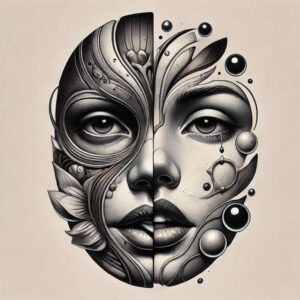
This tattoo concept blends a grayscale portrait with a geometric mandala, rendered in fine line tattoo technique with meticulous black and grey shading. The central element is a woman’s face, captured with careful contour lines, soft shading on the cheeks, and expressive eyes that hold a quiet intensity. Surrounding this focal point, a circular mandala expands outward using interlaced arcs, triangles, and subtle dot-work to create lace-like symmetry. The geometry is deliberate rather than decorative, designed to echo themes of balance, integrity, and transformation while leaving room for personal symbolism such as a lotus flower tattoo or infinity motif if desired. The piece relies on fine-line precision to preserve detail at smaller scales, yet is adaptable to larger canvases such as the back or sleeve. The color palette remains black and grey, ensuring classic longevity and compatibility with Japanese style tattoo or tribal tattoo design aesthetics. The composition offers strong negative space in select radii to enhance legibility over time and to facilitate potential cover-up of existing ink by distributing dense black areas with lighter transitions. From a technical standpoint, the line-work is clean and crisp, supported by restrained shading, with subtle transitions between zones to avoid harsh contrasts on the skin. In terms of meaning, the portrait speaks to identity and resilience, while the mandala conveys unity and cycles. This is an AI-generated tattoo project concept; professional artists can adapt it with micro-detailing, scale, and placement. Given its density and depth, it is particularly well-suited as a cover-up tattoo design, where the surrounding geometry can obscure prior ink while delivering a fresh, contemporary aesthetic. The design also aligns with trending tattoo concepts for small tattoos or larger body-art pieces, combining elements of realism with abstract geometry to produce meaningful tattoos in black and grey ink.