Description
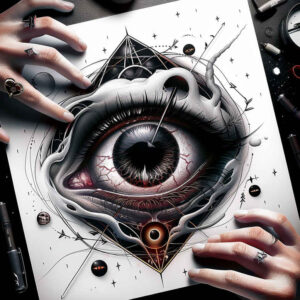
This AI-generated tattoo project presents an eye as the focal point surrounded by an expansive geometric mandala grid rendered in black and grey ink. The design blends realism with graphic linework, featuring a tightly observed iris and subtle scleral shading that contrast with crisp, decorative geometry. The sheet captures a drafting stage where the central eye anchors a radiating pattern of triangles, circles, and lace-like filigree, all arranged in a balanced mandala that invites close inspection. The visible hands and tools—paper, pen, pencil, and ruler—highlight the craftsman’s process from initial sketch to transfer-ready tattoo design. Technique emphasizes precise fine line control, smooth shading, and deliberate line weight variation to preserve legibility when scaled for small tattoos or placements behind the ear, on the wrist, or at the nape. The result reads as a versatile tattoo design with an emphasis on cover-up potential; the dense shading around the eye and the surrounding dark negative space offer camouflage for older marks, while the outward pattern provides contrast that can be tuned to skin tone and aging. In terms of meaning, the eye symbolizes perception and protection, while the mandala motif connotes balance, focus, and cyclical growth—a combination often sought in meaningful tattoos and adaptable to many body placements. The composition nods to Japanese style tattoo discipline through symmetrical geometry and clean line work, while staying within a black and grey palette that suits realistic tattoo aesthetics and timeless body art. As an AI-generated concept, it invites collaboration with a tattoo artist to tailor line thickness, shading gradients, and scale to the client’s anatomy and pain tolerance. The piece serves as a robust foundation for a cover-up project and demonstrates how graphic patterning can reframe an existing mark into a contemporary tattoo design—appealing to fans of fine line, lotus flower tattoos, infinity tattoos, tribal tattoos, and rose tattoo design families. It also references small tattoos and flower tattoos as potential directions, and it remains relevant to current ink trends, Japanese-inspired body art, and custom tattoo design workflows, making it a compelling template for studios aiming to show case-ready work and photorealistic black and grey tattooing techniques.