Description
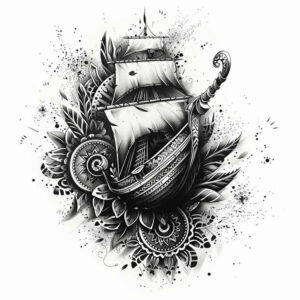
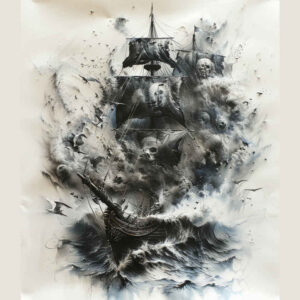
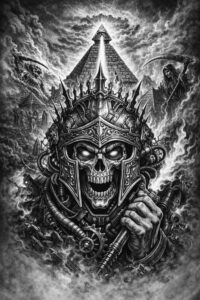
This AI-generated tattoo project presents a bold dragon-on-ship composition rendered in black and grey realism. The central figure is a sinewy dragon coiled along the weathered hull of a Viking-style vessel, its scales detailed in fine line shading that alternates between solid blacks and soft grey gradients. The ship’s planks are weathered and cracked, with torn sails and cracked masts suggesting a tide-worn saga. Surrounding elements—crashing waves, swirling mist, and scattered nautical debris—provide a dynamic frame that guides the eye along a sinuous arc from the dragon’s snout to the ship’s prow. The piece relies on contrast and meticulous line work to convey texture: lamination on the dragon’s scales, the grain of wood, the froth of water, and the metallic gleam of anchors or nails suggested by pinpoint highlights. The composition blends traditional motifs common to Japanese and tribal-inspired tattoo design with a modern black and-grey realist approach, making it suitable as a standalone piece or as a dramatic cover-up conceit for older ink. The dark tonal range allows it to mask underlying work while still revealing a narrative of resilience and exploration. For potential clients seeking a meaningful tattoo design, this concept offers strong symbolism: the dragon as a guardian or challenge, the ship as a journey, and waves as the ever-moving flow of life. In practice, this design can be adjusted in scale to fit forearms, shoulders, or backs, with the dragon’s head serving as a focal point and the hulls’ lines wrapping around the limb to create a cohesive body of ink. As an AI-generated tattoo project, it demonstrates how digital concept art can translate into bold, ink-ready fixtures that honor the wearer’s story while accommodating adjustments for line thickness and shading preferences. The result is a timeless black-and-grey tattoo design that embodies power, endurance, and myth, and its cover-up potential is a central advantage for clients looking to transform existing body art into something that reads as a new chapter rather than a rewrite.