Description
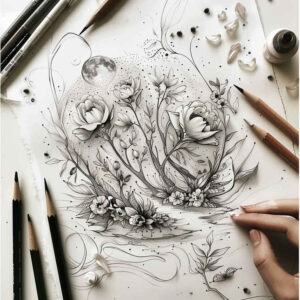
This AI-generated tattoo project concept presents a refined black and grey fine line floral study, centered on two roses with layered petals and a surrounding veil of leaves, all rendered in precise line work. The composition reads as a study sketch, with visible pencil lines and construction marks revealing its origin as a concept for tattoo design rather than a finished piece, offering a versatile foundation for a client seeking a delicate and timeless look. The key elements include two rose blooms, intertwined stems, and a cluster of leaves, with negative space carefully managed to preserve clarity when inked in black and grey; these features provide multiple pathways for customization, from adjusting line weight to adding subtle dot shading or a background. Symbolically, the rose stands for love and resilience, while the leaves suggest growth and renewal, a pairing that translates well to meaningful tattoos and small tattoos, or to larger body art projects as a floral motif. The technique emphasizes crisp fine lines and restrained shading, ensuring the design remains legible at small sizes while still delivering depth in larger applications, aligning with fine line tattoo aesthetics, realistic tattoo sensibilities, and the broader ink landscape of black and grey tattoos. This concept is adaptable to Japanese style tattoo or lotus flower tattoo adaptations if desired, as an example of how a botanical motif can cross stylistic boundaries into a custom tattoo design while preserving core motifs like rose tattoo design and flower tattoos. As a demonstration of AI-assisted ideation, it illustrates how a digital sketch can seed a custom tattoo design workflow, enabling artists to experiment with composition, balance, and narrative within a single cohesive floral study that can be refined into ink. The project also highlights practical considerations for tattoo artists: line economy, shading strategy, and placement planning for various canvases and client goals, with room to tailor the piece from a compact small tattoo to a larger piece, and to explore variations that integrate additional florals or cultural influences while preserving the central rose-and-leaf structure. In this context, the image serves as a polished reference for tattoo artists planning line work, shading strategy, and composition balance, illustrating how negative space and controlled gradients create depth without heavy saturation, and how a floral design can function across the spectrum of tattoo design, small tattoos, flower tattoos, and custom tattoo design, all within the realm of ink, body art, and contemporary black and grey tradition.