Description
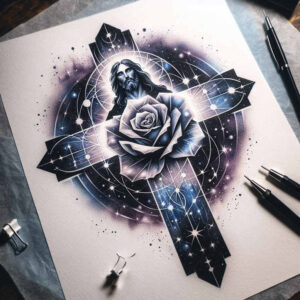
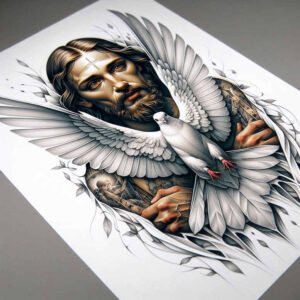
Presented as an AI-generated tattoo project, this piece renders a lifelike portrait of Jesus in grayscale on the chest, framed by a radiant halo and a crown of thorns. The composition relies on a disciplined balance of bold linework and soft gray shading to achieve a sculpted, three-dimensional feel that sits naturally with the contours of the body. The crown of thorns is illustrated with interlacing branches and slender, jagged spines, a potent symbol of sacrifice, endurance, and redemption that underpins the wearer’s faith. The halo blossoms into a field of sunburst rays that radiate outward, creating a spiritual crown of light that directs attention to the face and expression—eyes lifted, brow serene, a moment of quiet grace. The robe falls in measured folds, grounding the figure and providing negative space for breath and movement within the chest canvas. The interplay between geometric radiance and organic form gives the design a timeless, billboard-worthy presence, suitable for a confident large-scale tattoo or a refined smaller rendition depending on placement. The choice of black and grey ink preserves the solemn mood while allowing intimate details, such as subtle texture in the hair and the etched lines on the face, to read clearly over time. This concept embraces meaningful tattoos by telling a story of faith, sacrifice, and divine light; it also invites adaptation toward different cultural motifs or styles, including Japanese or traditional tattoo sensibilities, without losing its core symbolism. As an AI-generated tattoo project, it remains a flexible template for a custom tattoo design that can be scaled, refined, or extended with additional religious motifs. For clients seeking to cover up older work, the dense shading and strong silhouette offer a practical path: the composition can be widened or reoriented to mask previous ink while preserving the sacred aura. The halo rays reinforce the visual rhythm, integrating graphic elements that enhance legibility on skin, while never diminishing the central portrait’s emotional gravity.