Description
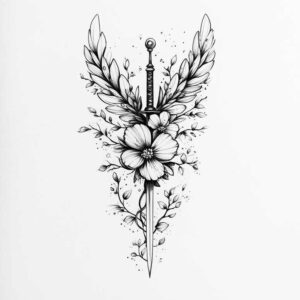
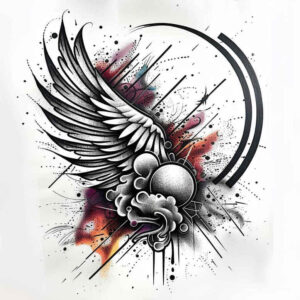
An AI-generated tattoo project concept designed for editorial review, this piece centers on a dense, radiating feather spiral framed by dispersed ink splatters. Rendered in black and grey, the composition relies on fine line workmanship and deliberate negative space to create depth within a circular motif. The dominant element is a spiral of elongated feathers that appears to wind outward from a central core, conveying motion, growth, and the idea of continuity. Ink splatters act as dynamic accents that fracture the rigidity of individual strands, injecting energy while preserving legibility when scaled to skin. The treatment balances strict line density with soft shading to achieve a realistic yet stylized texture, making it a versatile option for a cover-up where older tattoos lie beneath the feathered layers. Although rooted in natural forms, the design nods to graphic traditions—part tribal rhythm, part Japanese-style silhouette—yet remains adaptable to contemporary black and grey tattoo design language. In terms of symbolism, the feather evokes transformation and lightness; the spiral suggests infinity, renewal, and evolving identity, while the splatters symbolize energy bursts and the unpredictable nature of life. As an AI-generated concept, it demonstrates how digital design translates into tattoo-ready guidance, informing artists about line weights, density, shading strategy, and placement on the body. The concept scales from small tattoos to larger canvases, offering opportunities to integrate additional elements such as blossoms or geometric accents without sacrificing cohesion. This makes the tattoo design suitable for meaningful tattoos intended as cover-up solutions, while the graphic pattern carries a distinctive mood that can be tailored to individual taste in black and grey ink. Technical notes for tattooists include cross-hatching for midtones, stippling for subtle gradients, and feather barbs rendered with fine capillary lines to maintain readability on various skin tones; orientation and placement options span forearm, shoulder, or back as needed.