Description
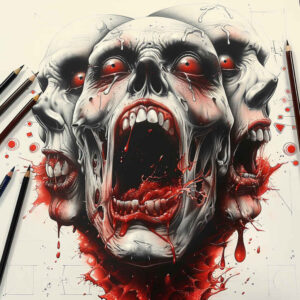
AI-generated tattoo project presents a cover-up ready composition built around a trio of skulls anchored by menacing daggers and a pool of blood. Rendered in black and grey with selective red accents, the piece relies on dense shading, crisp linework, and a graphic pattern to create depth, texture, and a striking sense of motion. Prominently, three skull forms rise from a mirrored, bloodied base, their voided silhouettes framed by dark blades that spear outward, guiding the eye through the composition. The design balances horror with artistry, offering a powerful statement in a single session or as a larger back- or chest-piece, depending on scale. For tattooers, the image translates into a realistic tattoo style, yet maintains strong silhouette readability for aging skin—a critical factor for cover-up work. The red highlights on the eyes and blood provide focal points, while the surrounding grayscale shading preserves contrast against existing ink. As a concept, this motif speaks to themes of mortality and danger, while staying within the realm of a custom tattoo design that can be adapted to various sizes and placements. The graphic pattern formed by the knives and skull edges gives the piece a cohesive, almost tessellated rhythm, ensuring it reads clearly from a distance and remains legible up close. Whether used as a standalone statement or integrated into a larger sleeve, the design embraces modern black and grey realism with a nod to traditional iconography, making it suitable for meaningful tattoos, fine line ink accents, or bold, high-contrast body art. The interplay of shading and negative space makes this concept especially amenable to a cover-up scenario, where old ink can be masked and reimagined into a new, dramatic tattoo design with lasting impact. AI-generated tattoo projects like this illustrate how algorithmic creativity can inform practical, commission-ready body art, providing a versatile blueprint that tattoo studios can adapt to client preferences while preserving the striking, graphic nature of the original concept.