Description
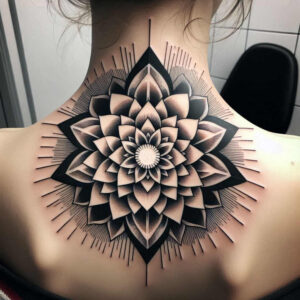
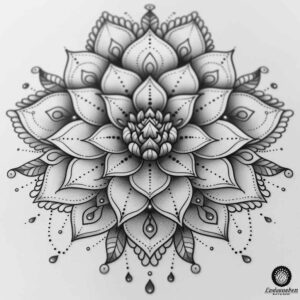
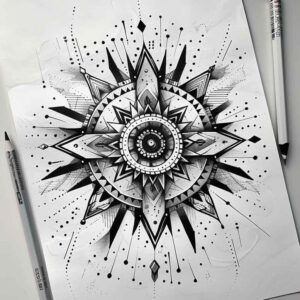
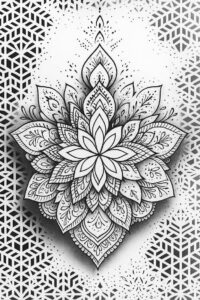
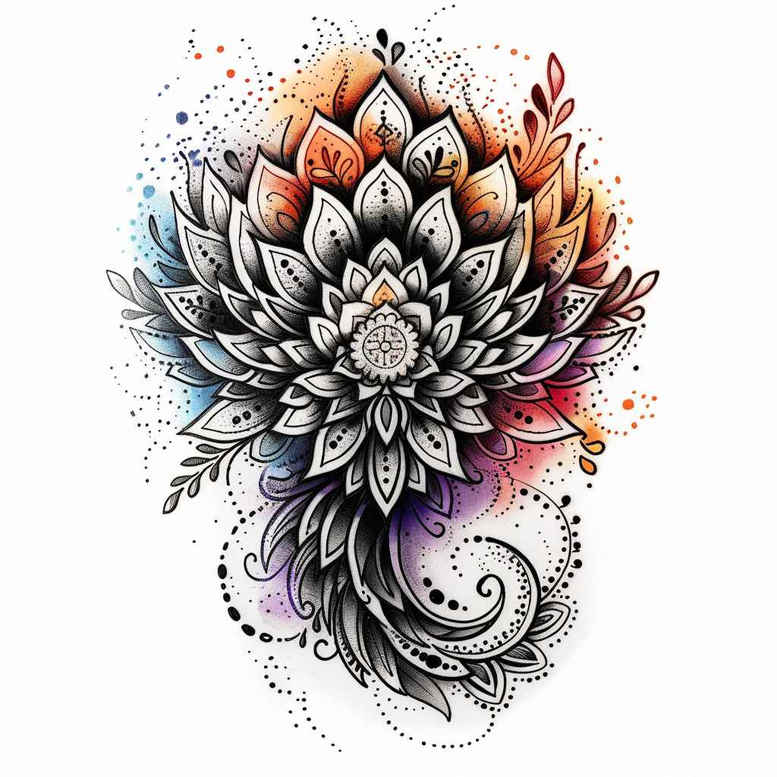
AI-generated tattoo project presented as a high-contrast, pattern-rich lotus design that blends traditional linework with contemporary dotwork sensibilities. The central motif is a lotus flower composed of dozens of finely drawn petals, each defined by narrow lines and subtle shading that builds a sense of three-dimensional depth. Surrounding the core, an intricate lattice of geometric and organic shapes extends outward in a mandala-like arrangement, enhanced by stippling and color accents at the rim. The overall composition balances heavy black ink with generous negative space, creating a bold silhouette that reads cleanly on skin and translates well into a tattoo design. Color is restrained to cool blue and violet highlights near the edges, with warm orange hints that provide contrast without overpowering the monochrome core. The technique emphasizes fine-line tattoo work and black-and-grey realism, delivering crisp edges and soft gradient transitions that hold up under aging and surface wear. Symbolically, the lotus embodies resilience, purification, and transformation, making this a meaningful tattoo design for someone navigating growth or recovery. The piece is deliberately dense in pattern, with an outer ring of delicate curves and dotwork that invites personalization—placing this on the forearm, shoulder, or upper back can scale from small tattoos to larger canvases. Because of its mass and the integration of black areas with negative space, it offers a constructive foundation for a cover-up by incorporating scar tissue or previous ink into the petals or surrounding filigree. From a professional perspective, the design demonstrates how AI-generated ideation can inform traditional tattooing while respecting practical ink considerations like line weight, healing behavior, and skin tone when rendering a finished piece. In sum, this lotus study blends Japanese-influenced linework with modern pattern density, producing a versatile tattoo design option that serves as a meaningful motif for a wide range of clients and placements. It also provides guidance for translating digital concepts into stencil-ready templates and exploring alternative color palettes to suit different skin undertones, further illustrating how AI-assisted ideation can support creative collaboration in tattoo studios.