Description
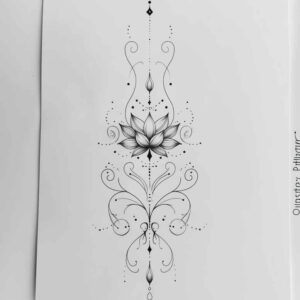
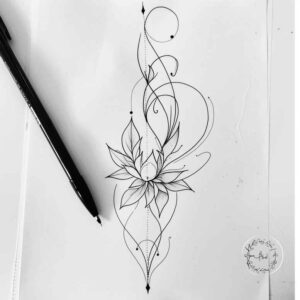
An elegant vertical composition centered on two lotus blossoms linked by flowing vines and ornamental scrollwork, rendered in pure black ink with crisp fine-line precision. The upper motif rises with curling tendrils and small bead-like accents that guide the eye toward the central lotus, whose petals unfold in symmetrical layers and establish a meditative focal point. A secondary lotus mirrors the top below, creating balance and a sense of growth along the design’s axis. The surrounding vines weave between petals and circular motifs, forming a repeating pattern that adds texture while preserving legibility. The approach favors clean outlines, negative space, and subtle shading to convey depth without muddiness, making it highly suitable for black-and-grey tattooing and for placement on forearms, ribs, or the spine. Symbolically, the lotus denotes renewal, purity, and resilience; the intertwining vines suggest connection and continuity, while the repeating pattern evokes rhythm and harmony. The piece reads as both a standalone design and a modular motif that can be expanded into a larger composition or used as a cover for lighter skin tones that require a bold line foundation. In terms of technique, this is a fine-line tattoo design realized with precision linework, careful spacing, and deliberate contrast to maintain readability at various sizes; it translates well to a realistic or graphic interpretation while staying true to a minimal, elegant aesthetic. The concept aligns with broader trends in flower tattoos, including related motifs like rose or lotus tattoo design, and it speaks to meaningful tattoos that balance tradition with contemporary line work. As an AI-generated tattoo project, it demonstrates how a structured, pattern-forward approach can yield a cohesive motif adaptable across different canvases, while maintaining clarity and stylistic integrity.