Description
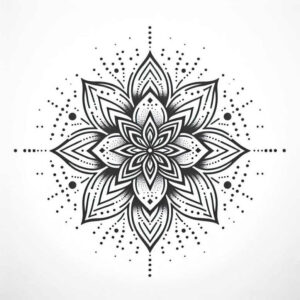
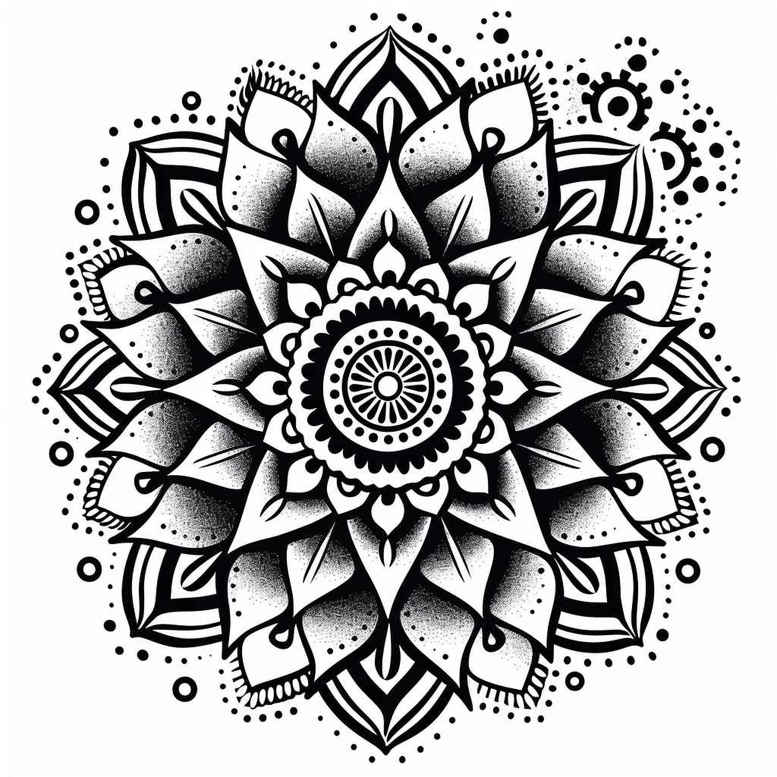
This AI-generated tattoo project presents a mandala motif executed in black and grey linework, a study in symmetry and restraint designed for a timeless tattoo design. The composition centers on a geometric medallion, with a dense circular core that radiates outward through concentric rings of petals, each layer carved with fine lines and deliberate dot shading to create depth and texture. The result is a graphic pattern whose precision invites close inspection, while its overall balance lends itself to various placements—from the back or shoulder to the forearm. The technique emphasizes clean contours, even tonal transitions, and careful spacing to preserve legibility at small sizes as well as impact when scaled up. The visual language draws on traditional mandala symbolism of unity, harmony, and focus; the petals become a floral interpretation of order, a nod to classic flower tattoo design without color, favoring the elegance of black ink on skin. In practical terms, this piece works well as an independent standalone tattoo or as a center motif within a larger sleeve, and it can be adapted with minor adjustments in size or line density to suit different skin tones and healing considerations. For clients seeking meaningful tattoos, the design offers a meditative narrative expressed through meticulous linework, negative space, and dotwork accents that enhance texture without compromising clarity. As a modern tattoo concept, it harmonizes with multiple genres including fine line tattoo aesthetics, geometric tattoos, and black and grey body art, while remaining compatible with both small tattoos and larger, more expansive commissions. The piece leverages pattern repetition and rotational symmetry to create a hypnotic rhythm that anchors a composition, supports flow with adjacent motifs, and remains legible across ranges of motion. This project also foregrounds technical aspects of ink density, shading gradients, needle selections for line precision, and the importance of steady hand control in achieving crisp edges. Finally, presented here as an AI-generated tattoo concept, it demonstrates how AI-assisted exploration can inform traditional design processes without replacing custom collaboration with an artist.