Description
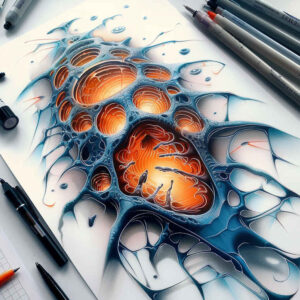
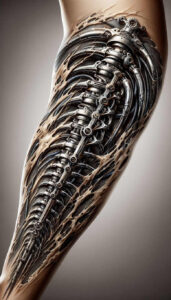
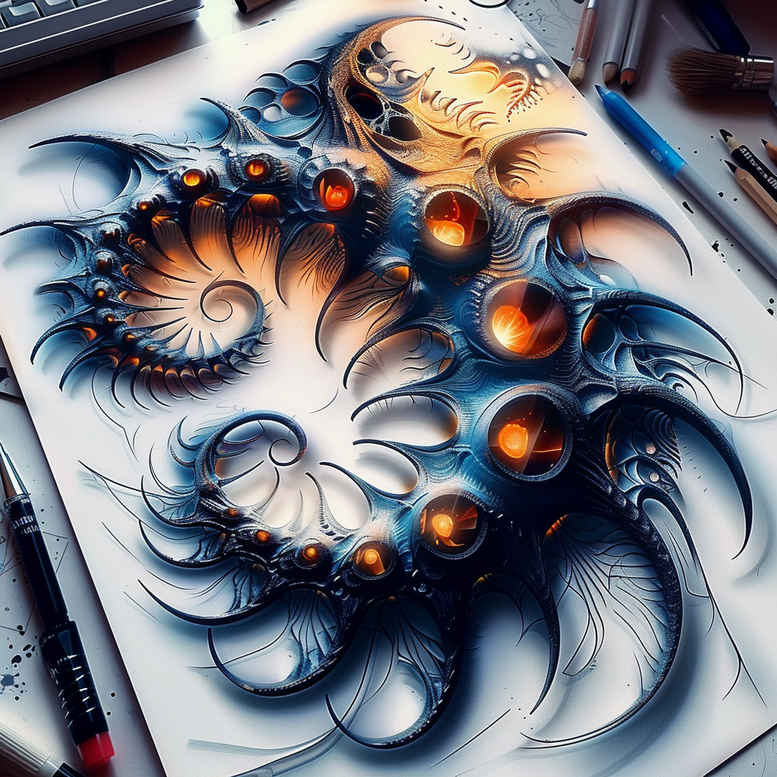
Biomechanical tattoo design merges organic anatomy with engineered machinery to form a dense network of curling fractal tendrils interlaced with bead-like orbs. The composition starts with a central hub from which spiraling tendrils radiate, creating a living circuit that travels along the skin with a sense of motion and depth. The color palette relies on blue and black shading to build volumetric contrast, with brighter highlights on the orbs to simulate polished glass or contained energy, while the dark areas anchor the piece and guarantee legibility across skin tones. The line work is meticulous and layered, balancing fine micro detail with broader shapes to preserve clarity when scaled down for small tattoos or expanded into larger sleeves. The repeated pattern of curved filaments and circular nodes produces a hypnotic rhythm that draws the viewer’s eye along the limb, offering a strong visual identity that sits comfortably in the biomechanical genre. The design explores themes of fusion, resilience, and the dialogue between organic tissue and man-made systems, making it suitable for meaningful tattoos that speak to personal transformation and identity. As a project concept and an AI-generated idea, it demonstrates how digital rendering can inform traditional tattoo design while remaining adaptable for cover-up applications, leveraging heavy black areas and modular motifs to mask prior artwork. Placement options include forearm, upper arm, or calf, with the fractal tendrils wrapping along contours and the orbs serving as focal accents. This approach fits both small tattoos and larger biomechanical explorations, delivering a contemporary ink that resonates with fans of high-contrast, illustrative line work and the broader vocabulary of tattoo culture: biomechanical, technocratic, and transformative body art. The imagery aligns with keywords such as tattoo, tattoo design, biomechanical, fractal, tendrils, orbs, cover-up, blue and black, small tattoos, and three-dimensional machine aesthetics.