Description
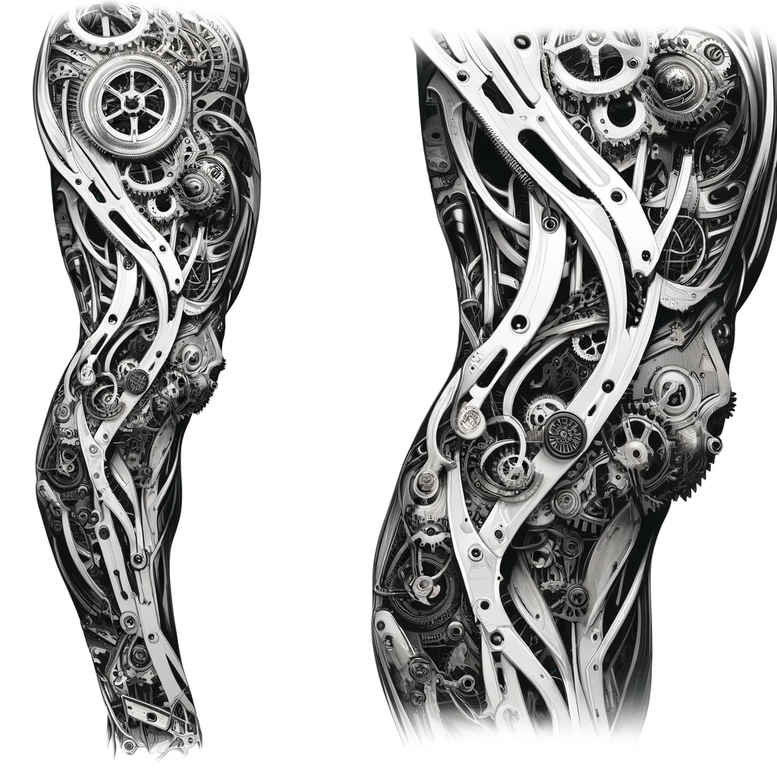
Biomechanical leg tattoo design presents a precise fusion of organic anatomy and engineered components, where interlocking gear wheels and sinewy tubing coil along the calf and wrap toward the thigh. The composition uses bold black ink with smooth grey shading to create high-contrast depth, while negative space forms micro sprockets and lattice lines that mimic an engineered dermis. The visual language blends mechanical exactness with biomorphic silhouettes, inviting interpretations of resilience, augmentation, and the dialogue between flesh and machine. Repeating motifs—gears, pistons, hoses, conduits—generate a rhythmic pattern that guides the eye along the leg, yielding a dynamic, legible design that reads well in photography. The layout favors a strong vertical silhouette that follows the leg anatomy, with variable line weights ensuring clarity from different angles, and it can be scaled into a full sleeve if desired. This concept aligns with contemporary black and grey biomechanics while offering a timeless body art statement for those seeking meaningful tattoos that fuse science and art. The idea has been informed by AI-generated sketches, but the final execution is crafted by a tattoo artist to ensure precise proportion, skin-safe shading, and durability over time. Given the dense black areas, the piece is perfectly suited for cover-up work, allowing new mechanical textures to blend with existing ink as needed. Its rhythmic circuitry-inspired path can be tailored to emphasize knee-to-thigh flow or ankle-to-calf transitions, inviting clients to customize tension, spacing, and focal points while maintaining a cohesive biomechanical narrative. As a striking wearable sculpture, it communicates a sense of modern myth—the body as machine, and the machine as partner.