Description
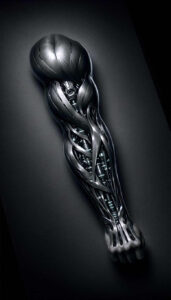
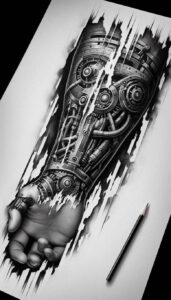
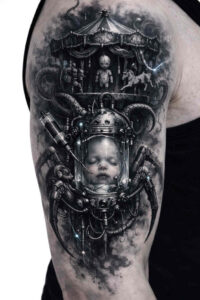
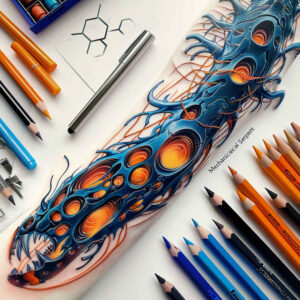
This biomechanical tattoo design fuses anatomy and machinery in a symmetrical composition centered on the torso. The core motif is a ribcage and spine rendered in black and grey, with two skulls perched near the shoulders and integrated mechanical elements—gears, wires, and pistons—woven through the skeletal form. The linework is precise, featuring tight contour lines, cross-hatching, and soft gradient shading to create depth and a convincing three-dimensional illusion. The ribcage appears to dissolve into a metallic framework, as if the living body is being revealed from within a machine, a quintessential biomechanical trope that blends flesh with engineered precision. The skulls add a stark counterpoint, evoking mortality while reinforcing the composition’s bold silhouette. Mechanical components thread through the design, creating a sense of movement and purpose without overwhelming the anatomy; the arrangement lets the spinal column act as the visual spine of the piece, guiding the eye top-to-bottom. The grayscale palette is restrained, with subtle red accents used sparingly to highlight core joints and connectors, lending focal points that draw the eye along the spine and ribcage. From a distance the tattoo reads as a bold silhouette, while up close the viewer discovers intricate textures, micro-shading, and tiny weld-like details that reward careful inspection. This is an AI-generated concept offered as a strong starting point for a custom tattoo design, and it is perfectly suited for cover-up applications thanks to its dense blacks and continuous shading that can mask existing marks. In terms of symbolism, the piece explores the fusion of biology and technology, resilience, and the tension between organic life and man-made systems, appealing to enthusiasts of blackwork and biomechanical styles for meaningful tattoos and large-scale body art. Whether placed on the back or chest, the design delivers a dramatic statement with high-contrast imagery, crisp lines, and a timeless fusion of anatomy and machinery that remains legible across sizes. Artists may adapt the composition by shifting skull positions, altering gear density, or adding ornamental motifs to personalize the piece for the wearer.