Description
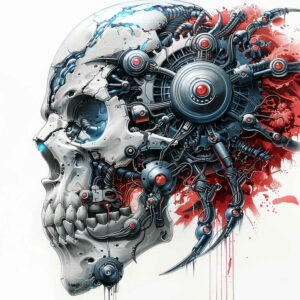
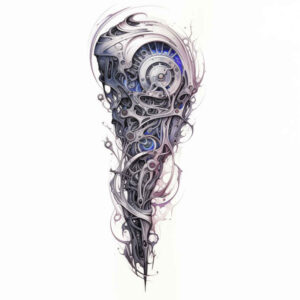
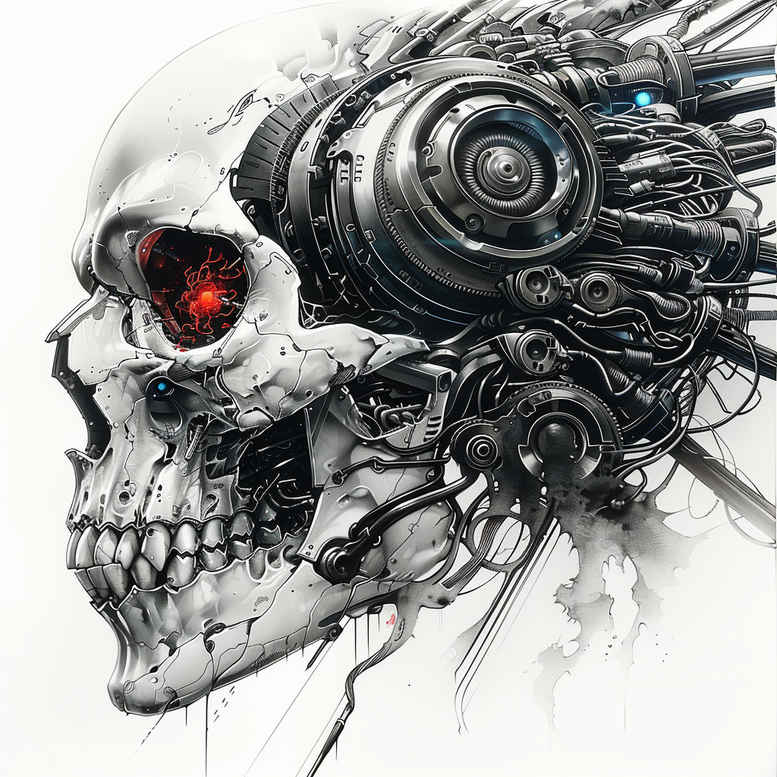
Biomechanical skull fused with gears and tubing is presented in a hard-edged black and grey palette, merging anatomical realism with industrial machinery. The composition centers on a skull profile where pistons, gears, and cables weave through the cranium, creating a layered, three-dimensional effect that suggests hidden mechanisms beneath skin. The high-contrast shading moves from deep blacks to soft grays, emphasizing volume and the metallic sheen of chrome-like surfaces while preserving the organic sinuosity of bone. This tattoo design explores the dialogue between flesh and alloy, expressing themes of resilience, transformation, and the modern interface between biology and technology. The visual language borrows from technical illustration: gear teeth interlock with the jaw, riveted joints trace the contour of the cheek, and hydraulic lines follow the curves of the skull to imply motion and force. The result is a dramatic, statement-making piece suitable for large canvases such as the back, chest, or shoulder blade, where the intricacy remains legible at distance and up close. The biomechanical style is enhanced by careful composition: negative space around the eye socket, deliberate asymmetry, and a rhythm of circular and angular forms that guide the viewer through the tattoo design. While the artwork appears highly engineered, it retains a human focal point in the skull, preserving personal meaning for the wearer. This concept is frequently AI-generated to test algorithm-driven iterations of mechanical anatomy, and this particular example highlights how digital workflows can translate into a wearable, timeless body art piece. In practice, it offers tattoo artists a robust blueprint for crafting a custom biomechanical narrative that blends science fiction aesthetics with traditional tattoo techniques, producing a striking, enduring image that communicates power, curiosity, and the fusion of man and machine. Collectors of dark, bold body art will appreciate how the biomechanical motif translates across sizes, and the design supports variations that keep the gears readable even when inked in restrained scales. The concept remains a flexible framework for customization, inviting artists to tailor the gear counts, tubing paths, and skull anatomy to the wearer’s anatomy and personal symbolism, while maintaining the crisp black lines and smooth shading that define the biomechanical tattoo tradition.