Description
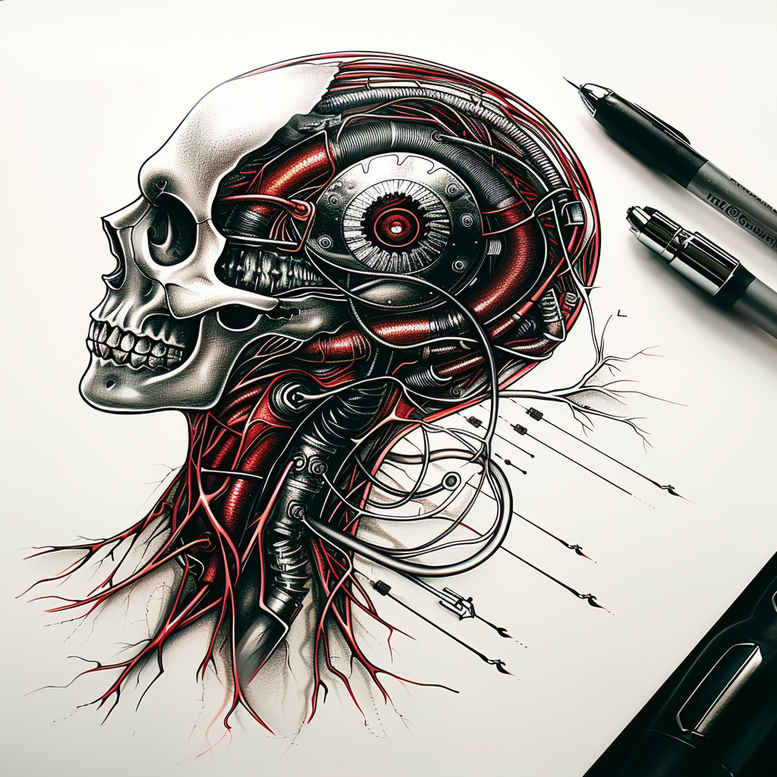
An audacious biomechanical tattoo concept that blends anatomy and engineering into a single, cohesive piece. The design centers on a human skull, rendered in meticulous black and grey shading, whose cranium dissolves into an array of gears, tubing, and sinewy conduits. The interplay of solid shadows and fine line details creates a sense of depth and three-dimensional form, as if the wearer carries an internal machine beneath the skin. Circular gear elements—solenoids, pistons, and rotor-like rings—interlock with delicate cables, veins, and micro-splines, producing a visual language that sits at the crossroads of anatomy and industry. The red accents along some arteries provide a striking contrast that brings warmth to the otherwise monochrome palette, adding a focal point that catches the eye and invites closer inspection. The composition emphasizes a diagonal flow from the jaw upward into the cranium, guiding the viewer through layers of mechanical tissue while maintaining a readable silhouette for placement on the upper arm, chest, back, or calf. As a tattoo design, it operates well within black and grey conventions, but the red highlights lend a contemporary edge and can be scaled for small or large tattoos depending on the subject’s preferences. This concept is AI-generated, offering a high level of precision and imaginative fusion that can be refined by a skilled tattoo artist into a custom tattoo design. In the realm of meaningful tattoos, biomechanical motifs symbolize resilience, transformation, and the fusion of human and machine, appealing to fans of cyberpunk aesthetics, industrial art, and science-inspired body art. For collectors seeking a bold statement piece, the skull motif conveys mortality while the exposed machinery suggests resilience and an attitude of repair, making this concept particularly versatile for cover-up explorations or statement pieces. The repeating circuit-like elements introduce a pattern sensibility that can be accentuated or toned down to suit personal taste, and the design remains legible across a variety of body placements, from forearm to shoulder blade, making it a versatile platform for future expansions or additions to a larger biomechanics sleeve.