Description
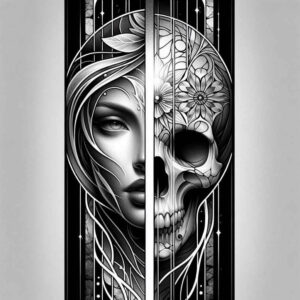
This black and grey realism tattoo design presents a bold, split composition that fuses a skull on the left with a lifelike face on the right, anchored by a dagger that descends from the center. The high-contrast shading uses crisp blacks and smooth midtones to sculpt bone and skin textures, while fine lines define dental detail, eye sockets, and subtle facial contours. The overall effect is a dramatic chiaroscuro portrait that plays with light and shadow, creating a tense tension between mortality and humanity. The left skull is rendered with weathered contours and hollow cavities, conveying age and decay, while the right side hints at a living expression, suggesting resilience or introspection beneath a mask of darkness. The dagger at the bottom acts as a visual pointer, directing the viewer’s gaze upward and tying the elements into a single vertical rhythm. This piece relies on a limited palette to emphasize form over color, focusing on texture, contrast, and negative space to make the subject feel tangible yet enigmatic. The design nods to traditional tattooing while pushing the boundaries of grayscale realism through meticulous shading, cross-hatching, and smooth gradient transitions that read clearly from a distance and up close. Symbolically, the juxtaposition of skull and face can be read as the coexistence of impermanence and identity, a meditation on what endures beyond death, while the dagger adds a note of danger, decisive action, and protection. The concept is AI-generated, offering a contemporary edge and a clean, scalable silhouette suitable for a large canvas. Because the composition includes large black areas, the image is particularly well-suited for a cover-up on a darker skin tone or over existing work, allowing a skilled artist to layer new elements over the shadowed regions without losing detail. In sum, this tattoo design marries classic grayscale technique with a modern split-figure motif, delivering a striking subject that remains legible and impactful in any size, whether placed on an upper arm, back shoulder blade, or chest panel.



![Objects: [dagger, guard, blade, scrollwork, flower] in black and grey; tattoo project; cover-up ready.](https://inkby.ai/wp-content/uploads/2024/06/weapons-tattoo-design-ideas-ai-generated-tactical-design-for-back-InkByAI-300x300.jpg)