Description
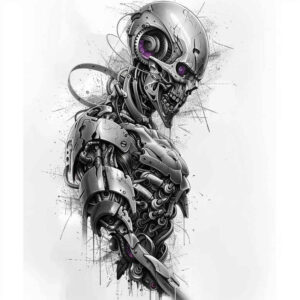
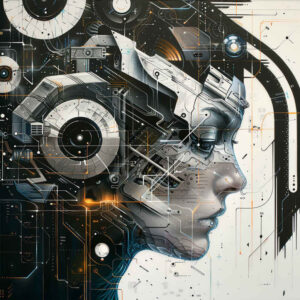
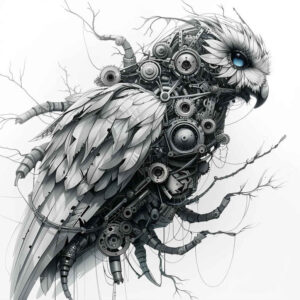
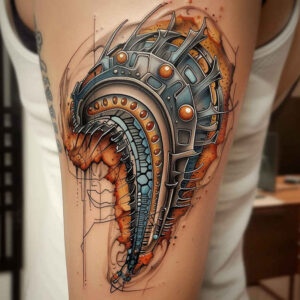
This black and grey biomechanics tattoo design centers a lifelike female portrait that appears to surface from a lattice of mechanical components, with gears and cogs curling around the temples, jawline and neck, while faint pistons and micro-shims hint at motion beneath the skin. Surrounding the face, interlocking puzzle pieces anchor the composition, evoking themes of memory, identity and the idea that self is assembled over time. Softly spined roses braid through the machinery, their petals offering a counterpoint of organic curvature to the angular geometry of metal, a classic motif that grounds the piece in both romance and resilience. The overall composition is vertical and carved with meticulous black and grey shading, using a full tonal spectrum from near-ink black to delicate highlights to create depth and realism. The artist renders skin texture with subtle stippling and smooth gradient transitions, while the metal surfaces catch light with crisp edges and reflective specular hints, lending a photographic quality to the work. The design plays with contrast: the smooth skin of the portrait against the harsh mass of gears and blocks, the organic flow of the roses against the rigid, modular pieces, and the interplay of negative space that lets the eye wander along the forearm’s length. Symbolically, the piece speaks to the tension between humanity and machinery, memory and reconstruction, vulnerability and strength, making it personal to someone contemplating change, adaptation or renewal. As a concept, it remains highly legible from a distance while inviting closer study of the tiny details—tiny screws, floral shading, and puzzle-piece edges—that reward repeated gazes. Because the piece contains large areas of solid black and dense shading, it is especially suitable as a cover-up design, capable of concealing older ink while preserving the legibility of the portrait. This AI-generated concept demonstrates how contemporary algorithms can inspire intricate, magazine-ready tattoo ideas that balance technical realism with symbolic poetry, positioning the wearer at the intersection of art and engineering in a bold, lasting statement.