Description
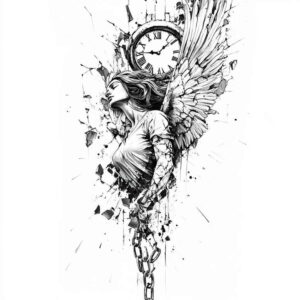
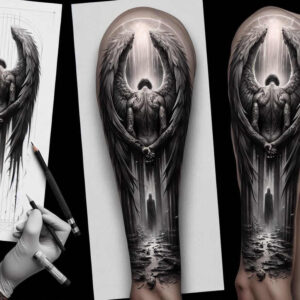
An elegant grayscale tattoo design centered on a rosary draped across a Gothic arch, with a cross pendant at the bottom and an angel figure poised to the left. The piece is rendered in black and gray realism with fine line work and smooth gradient shading that capture the tactile textures of beads, metal clasps, fabric folds, and feathered wings. The rosary beads curve from the arch’s apex down toward the cross, creating a vertical rhythm that anchors the composition. The arch frame acts as a sacred stage, giving the design a cathedral-like presence that feels both timeless and contemporary. The angel is rendered with delicate anatomy and detailed plumage, conveying quiet guardianship, while the cross radiates subtle highlights that suggest light refracting through the beads. Compositionally, the work balances negative space with dense hatch shading to produce depth, while the grayscale palette emphasizes mood over color, making the image versatile for placements on the body. Symbolically, the rosary evokes prayer perseverance; the cross stands for sacrifice, and the angel signifies protection and guidance—messages that resonate across cultures and personal histories. The design reads as a modern interpretation of classic religious iconography, suitable for memorial purposes or personal devotion, and its high-contrast line work ensures legibility at tattoo sizes from small to large. Technique-wise, a mix of smooth shading, fine lines, and subtle stippling creates texture on skin, metal, and fabric, while highlights on the beads give them a round, tactile feel. As an AI-generated concept, it demonstrates how traditional motifs can be translated into contemporary ink language, inviting adaptation of scale, line weight and placement to the wearer’s anatomy.