Description
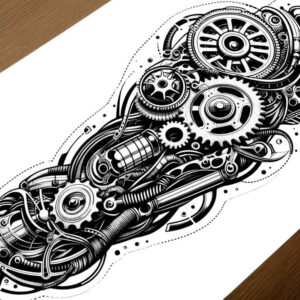
An intricate black-and-grey mechanized composition is revealed on torn paper, presenting a bold tattoo idea that fuses machinery with precise linework. The design relies on fine-line technique to render interlocking gears, pistons, cylinders, and rings that spiral toward a central hub, creating depth and a sense of motion. The torn edge acts as a dramatic frame, contrasting the white surface with dense graphite shading and solid blacks, making the piece highly legible as a tattoo when transferred to skin. Executed in a high-contrast black-and-grey palette, the artwork emphasizes negative space around the core machinery to allow clean application and potential cover-up where old ink is darker or more complex. The central wheel motif serves as a focal point, while radiating spokes and layered components convey industrial aesthetics and a touch of futuristic pragmatism. The pattern-like arrangement is designed to flow with body contours, ideal for forearm, calf, or back placements, and remains readable when scaled down for small tattoos. Despite its machine-age look, gentle gradients simulate metallic sheen on gears and bolts, lending a sense of realism within the stylized geometry. Symbolically, the piece can represent precision, resilience, and transformation, with each cog suggesting a turning point in a personal journey. This is an AI-generated tattoo project exploring algorithmic design in body art, underscoring how modern tools can produce detailed, high-contrast linework suitable for a custom tattoo design. For clients seeking a powerful cover-up, the dense machinery and patterning provide effective concealment of darker tattoos, while offering a striking, contemporary aesthetic that can be tailored to individual anatomy. In the broader context of tattoo art, the design aligns with black and grey realism and fine-line sensibilities, while remaining adaptable to variations in size and placement. The result is a statement piece that blends mechanical imagery with tattoo craftsmanship, inviting exploration of meaningful tattoos and the growing role of technology in ink.