Description
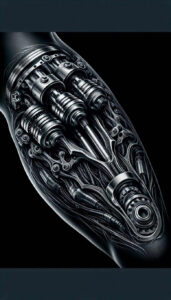
This AI-generated tattoo project presents a hyper-detailed cybernetic skeleton that appears to breach a torn sheet of paper, a visual mash of biology and machinery. The central figure is a human-like skeleton reinforced by mechanical components—ribs replaced by alloy segments, shoulders threaded with cables, and an arm rendered as a robotic limb with pistons and articulating joints. Around the figure, irregular torn edges reveal a dark void behind, creating depth and the sensation that skin is peeling away to expose a hidden interior of gears, tubes, and micro-wiring. The studio props visible in the photograph—the pencil, metal tools and drafting instruments—anchor the concept in a real-world tattoo workflow, reminding us that this is a design ready to be transferred to skin as a custom tattoo design. The palette is deliberately monochrome: blacks and greys sculpt the musculature and the metallic surfaces, with white highlights catching on chrome surfaces to enhance the sense of relief and texture. The technique emphasizes fine line precision for the circuitry traces, dogbone joints, and clutching gears, while broader shading defines the contours of the rib cage and the hum of moving parts beneath the skin. The juxtaposition of bone and machine invites reflection on resilience, transhuman aesthetics, and the interplay between human identity and technology in a modern body art narrative. The piece reads as a powerful example of black and grey realism in tattoo design, its graphic patterns of circuitry and segmented plating functioning as a built-in pattern that can be adapted across areas of the body. Because the image leans toward darkness and dense mechanical detail, it is especially suitable as a cover-up tattoo design; viewers are drawn into a narrative where the old tattoo can be replaced by an intricate cybernetic portrait. The description here acknowledges its AI-generated origin, underscoring how contemporary tattoo studios are experimenting with machine-assisted concepts to deliver crisp lines, durable shading, and scalable compositions that work across small and large canvases alike, while remaining meaningful and evocative within the broader tattoo discourse.