Description
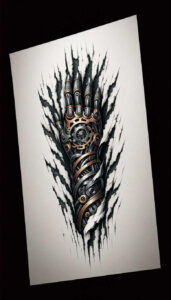
An intricate, hyper-detailed cybernetic forearm dominates the frame, composed of interwoven tubes, segmented cylinders, and exposed gears that weave into a sculptural sleeve. The design reads as a fusion of biology and machine, with a central spine of lit cores where blue and crimson light threads pulse along the length, suggesting energy flowing through the circuitry. The metallic surface is rendered with flawless shading to mimic brushed steel, rivets, and discreet hydraulics, while highlights and soft gradients give the impression of depth and weight. The artist has balanced negative space with densely packed segments to create a rhythm that guides the eye from wrist to elbow. This AI-generated tattoo project leans into a futuristic aesthetic, suitable for a full forearm cover-up due to its dense, interlocking motif that can obscure existing ink beneath its tubes and plates. The piece operates in a color-forward palette, using full color to emphasize the graphic pattern of the assembly, with blue cores contrasting warm red accents to evoke energy and vitality. From a technique standpoint, the design reads as a high-detail digital illustration translated into scalable tattoo-ready line work and shading; the mix of hard-edged metal surfaces and luminous core elements demonstrates a modern realist approach within the broader body art tradition. The motif can be adapted to other body regions, inviting variations that explore the balance between organic form and mechanical structure, making it a compelling choice for meaningful tattoos or for collectors seeking a bold statement piece. As a tattoo concept, it sits at the intersection of cyberpunk-inspired machinery and contemporary realism, offering synergy with black and grey interpretations if desired, while preserving its impact in full color. Note that this is an AI-generated tattoo project, designed to showcase a robust cover-up option and to explore how metallic tattoo design can translate the feel of industrial machinery into wearable ink. The repeating tubular pattern and interlaced connectors form a graphic rhythm that suits large scales and smaller panels, depending on placement and curvature.