Description
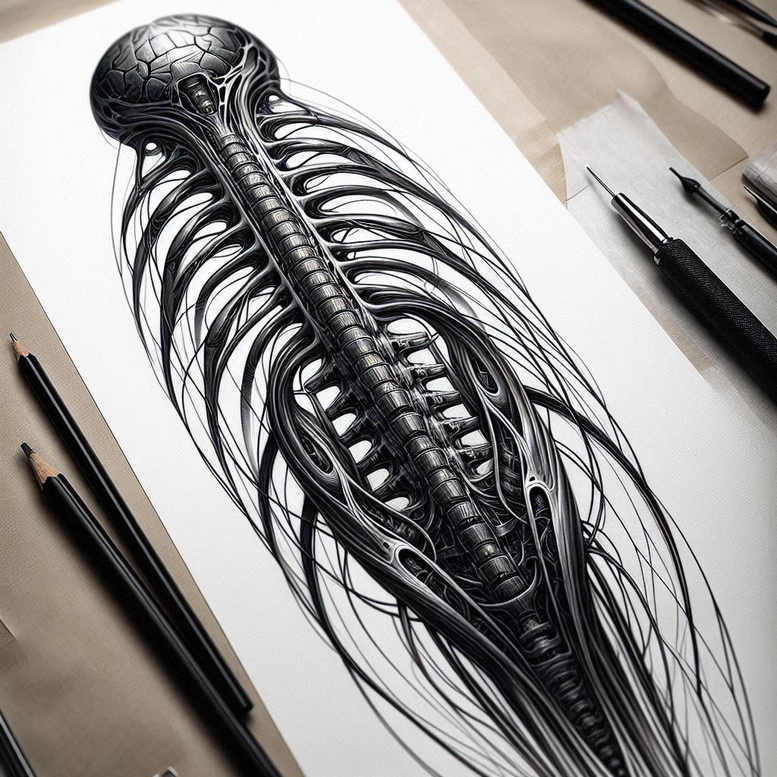
AI-generated tattoo project concept featuring a biomechanical jellyfish, rendered in black and grey on white drawing paper. The central body resembles a segmented exoskeleton with a ribbed spine, from which wiry, tentacle-like filaments extend in a careful interplay of line weight and negative space. The shading relies on fine line work and smooth grayscale transitions to create depth, giving the illusion of chrome, bone, and sinew braided into a living machine. The composition reads as a standalone piece or a starting point for a sleeve, with strong contrast and fluid motion that translate well to skin. Although this is a concept, the design demonstrates a potential tattoo design that blends biomechanical aesthetics with marine symbolism, referencing resilience, adaptability, and transformation. The motif can be scaled for large placements or adapted into smaller, fine line tattoos for collectors seeking a distinctive, modern piece. This study emphasizes black and grey ink, precision linework, and deliberate spacing to maintain legibility when reduced. In symbolism, the jellyfish suggests resilience and grace beneath turbulent currents, while the mechanical elements imply engineered strength—together signaling balance between nature and technology. As an AI-generated tattoo project concept, it suits clients pursuing meaningful tattoos, custom tattoo design, and pattern-inspired body art that leans toward Japanese style tattoo influences, with clean black and grey shading rather than color. It also serves as a versatile reference for cover-up considerations, thanks to its bold silhouette and high-contrast detail that can mask or integrate with existing work.