Description
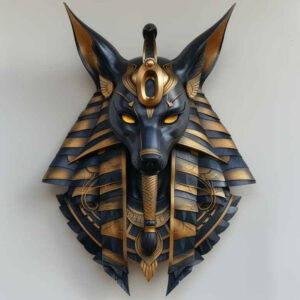
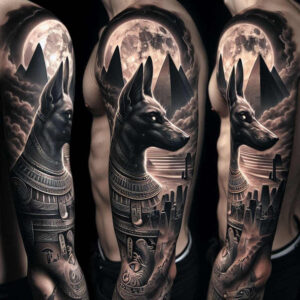
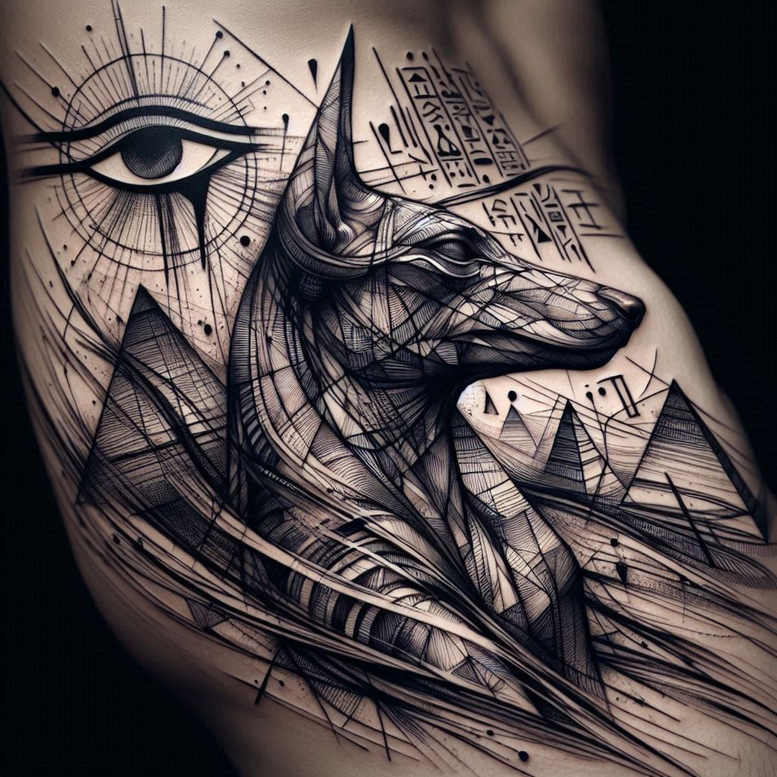
This entry is a tattoo gallery piece inspired by Anubis from Egyptian mythology, presented in a geometric, line-heavy aesthetic. The design centers a jackal head rendered from interlocking triangles, facets and crisp lines that read as a modern biomorphic mask rather than a literal portrait. The composition uses negative space to carve the neck, ears and keen eye, while an underlying lattice of angular planes generates motion, depth and a sense of timeless myth. Executed in black and grey, the shading builds density toward the outer silhouette, producing a bold, readable silhouette up close and a nuanced texture from a distance. The work sits within contemporary blackwork and geometric tattoo traditions, drawing on clean linework and architectural precision to emphasize form over shading alone. Symbolically, Anubis embodies protection, transition and the journey of the soul; the jackal head acts as guardian over thresholds, while the geometric facets allude to the layered nature of existence, memory and identity. Triangular shapes and pyramidal facets function as directional cues—toward insight, resilience and renewal—while the tessellated surface suggests the multifaceted character of life and the afterlife. For meaningful tattoos, this piece pairs mythic resonance with a design language that feels both ancient and current, making it a strong choice for placement on the arm, shoulder or calf. The repeating geometry creates a rhythmic pattern that enhances visual cohesion and invites closer inspection, reinforcing the idea of ritual symmetry rather than casual ornament. This is an AI-generated concept, and its fusion of line, shade and negative space invites personal interpretation within the wearer’s own narrative. Given the density of black areas, the design also stands as a powerful cover-up option, capable of concealing underlying imagery while retaining a striking, legible silhouette for years to come.