Description
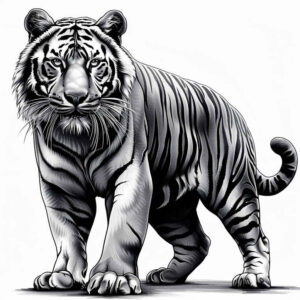
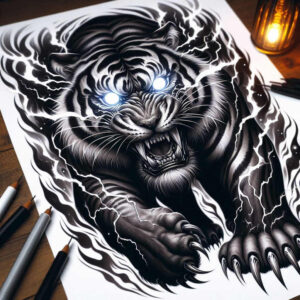
This AI-generated tattoo project concept presents a tiger portrait rendered in a dynamic watercolor technique, where saturated orange and black tones bleed into translucent whites and grays to create fur texture and depth. The composition centers on the tiger’s face, with piercing amber eyes and a blunt, confident expression that anchors the piece, while crisp linework around the muzzle and whiskers defines structure. Surrounding splashes and angled geometric accents form a loose V-shaped motif that adds balance and motion, guiding the eye toward the animal’s powerful gaze. The color palette relies on bold orange and black stripes, accented by white highlights to emphasize texture, light, and contrast. The brush-like edges and splatter effects evoke the spontaneity of traditional watercolor while maintaining clear silhouette suitable for transfer to skin. For tattoo artists, this concept blends realism with modern graphic patterning: the tiger’s facial features are treated with careful shading and micro-details, while the surrounding ink bleeds create a contemporary pattern that can be scaled to fit forearms, shoulders, backs, or calves. The tiger symbolizes strength, courage, and protection, making it a meaningful tattoo choice for clients seeking personal symbolism in a striking design. As an AI-generated tattoo project, it demonstrates a forward-looking approach to custom tattoo design, showing how digital composition can pre-visualize ink on skin and inspire unique placements. While the palette leans color-forward, the core composition can be adapted to a black-and-grey version for clients who favor a more subdued aesthetic, preserving the same pattern elements and balance. The piece also nods to influences from Japanese style tattoo and modern fine-line tendencies, where bold color fields meet precise linework and negative space to create a visually arresting body art image. In short, this tiger study offers a robust starting point for a tattoo design that blends emotional meaning with technical finesse, and it invites customization of size, placement, and line weight to suit individual bodies and stories, including considerations for a cover-up if existing ink requires it.