Description
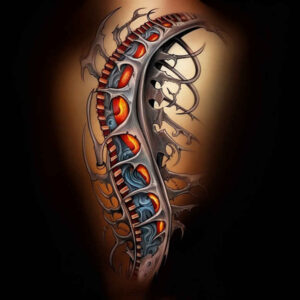
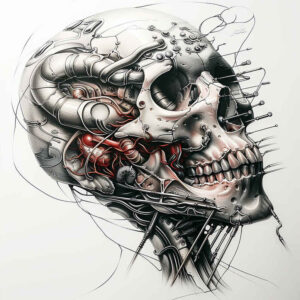
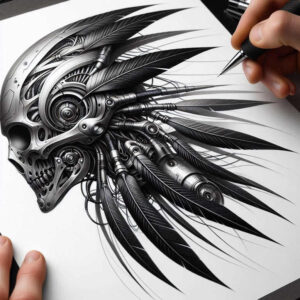
This AI-generated tattoo project translates a cybernetic skull into a high-contrast black and grey study that reads as a powerful sleeve design. The central motif is a realistic skull whose cranial anatomy is reimagined with intricate machine parts, circular optical lenses, and jagged architectural shards that fracture the face into a pattern of circuitry and steel. Red accent lines glow behind the eye sockets, providing a striking contrast against the dense black shading and fine line work that defines the piece. The composition tapers along the upper arm with vertical strips that evoke a cityscape reflection, merging urban dystopia with a biomechanical aesthetic. The technique blends smooth gradient shading, crisp line work, and knife-edged highlights to render depth and texture, a hallmark of modern tattoo realism. The piece relies on negative space to create dimensionality and to allow the viewer to read both the skull and the machine elements as separate but interconnected motifs. Symbolically, the skull anchors the theme of mortality, while the cybernetic enhancements imply resilience, transformation, and the fusion of human and machine—an idea frequently expressed in meaningful tattoos and custom tattoo design. While the design sits firmly in a black and grey palette, the red neon accents and polished metal surfaces give it a contemporary street-leaning vibe akin to Japan-inspired, cyberpunk, or Japanese style tattoo aesthetics. The arrangement sits well across a sleeve or leg, inviting long, flowing ink that can be extended or adapted for small tattoos to create a cohesive body art piece. Given the image’s dense darkness, this tattoo project is particularly suitable as a cover-up, where thick black areas can mask prior work while the layered pattern and detail maintain visual impact; the design remains legible, scalable, and adaptable for a variety of skin tones and body placements. In sum, this cyborg skull tattoo design embodies the intersection of realism and graphic pattern, offering a bold, modern interpretation within the broader canon of ink practices.