Description
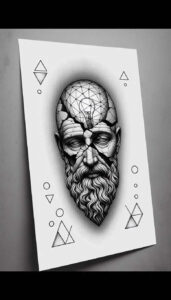
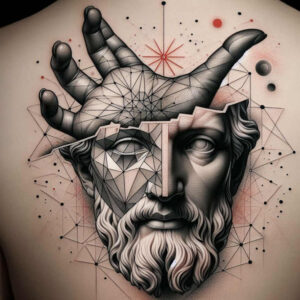
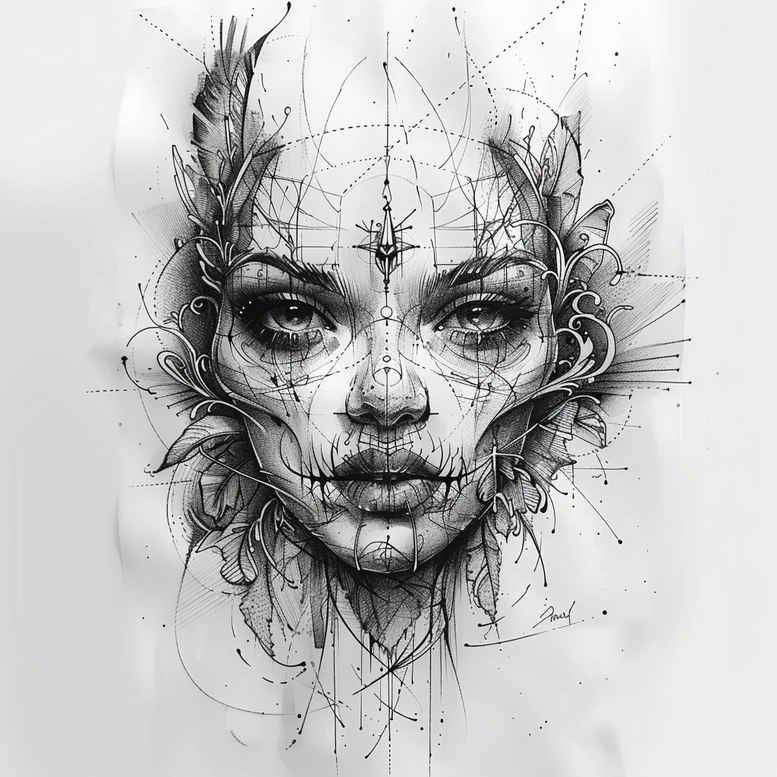
An AI-generated tattoo project concept, this design presents a portrait-like face that emerges from a web of intersecting lines and fragments, blending realism with abstract patterning. Executed in black and grey with a fine-line approach, the piece relies on subtle gradations of ink and negative space to sculpt the facial features while letting the surrounding tracery breathe and shift. The central visage, rendered with careful attention to eyelid, brow, and mouth, carries a quiet intensity that invites personal interpretation, while the outer lattice evokes motion, fragmentation, and transformation. The interplay of dense blacks and delicate lines creates depth without overpowering the subject, making it adaptable to placement on the forearm, calf, or back of the shoulder. This concept suits meaningful tattoos that symbolize resilience, metamorphosis, or hidden narratives; it remains easily adjustable to a larger canvas or simplified into a refined small tattoo. Patterned elements around the face can be treated as ornamental filigree, amplified into a full tribal or Japanese-inspired line-work motif, or integrated with floral hints such as a lotus or rose tattoo design for a hybrid composition. Because of the strong dark shading, the piece is particularly well suited for a cover-up, capable of masking older ink or scar tissue with a fresh black-and-grey rendition. In practice, this design reads as a viable custom tattoo design for artists seeking to balance realism and abstraction; it is ideal for tattoo studios aiming to deliver meaningful tattoos that satisfy clients seeking a bold, archival-grade body art piece. Note: this concept emphasizes that it is an AI-generated tattoo project concept, and it can be refined to match individual skin tone, line thickness preferences, and placement constraints, always considering cover-up potential and pattern-rich typography.