Description
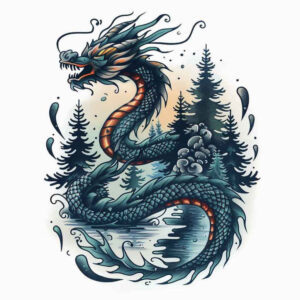
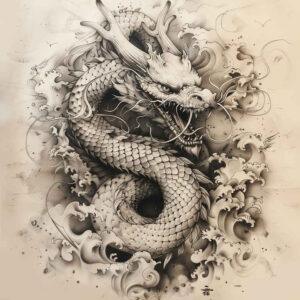
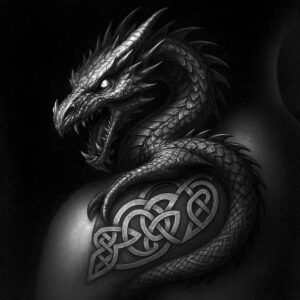
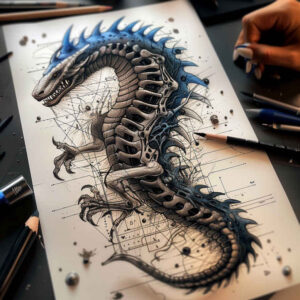
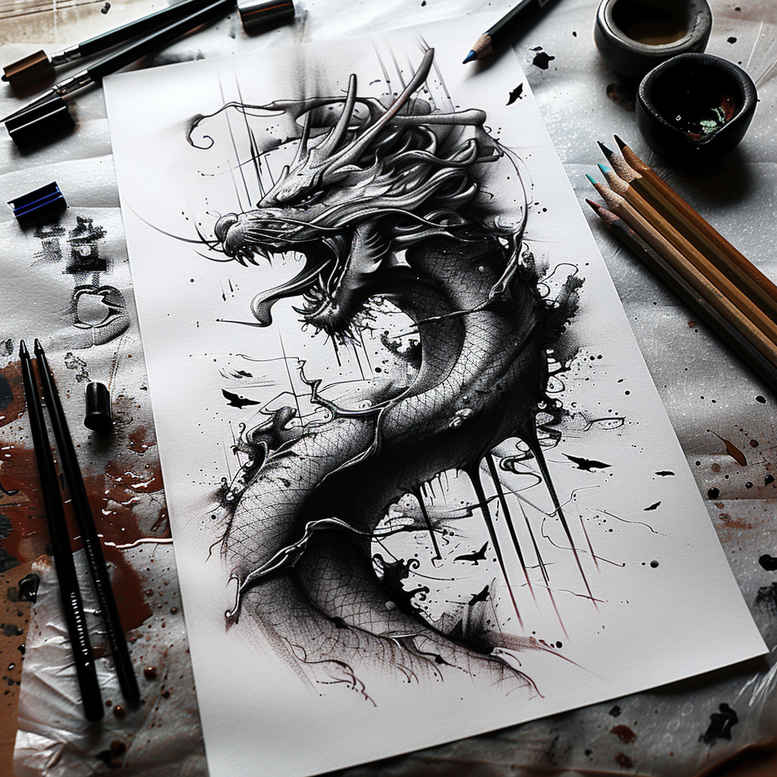
Presented here is a study for a dragon tattoo design rendered in black and grey on a sheet of paper, accompanied by an ink bottle, a brush, and a pencil. The image reads as a draft rather than a finished piece, but the line work and tonal shifts already demonstrate core tattoo design principles: clarity of silhouette, controlled contrast, and expressive movement. The dragon coils in an S-shaped arc, its sinewy body adorned with scales and spiky ridges that dissolve into splatters, producing a bold graphic pattern that remains legible as a stand-alone motif or as part of a larger composition. The technique leans toward fine line tattoo aesthetics in its crisp line work while employing soft shading to imply volume, fitting both black and grey and realistic tattoo sensibilities. The surrounding ink splashes give an atmosphere of dynamism, echoing traditional Japanese style tattoo influences while staying accessible for a contemporary body art project. Symbolically, dragons evoke courage, protection, and transformation, making this a meaningful tattoos concept for someone seeking significant ink with personal resonance. The motif pairs well with other motifs such as lotus flower tattoo or infinity tattoo as a legible, fluid transition—useful for small tattoos on the wrist or ankle, or as a cornerstone for larger flower tattoos or tribal tattoo-inspired sleeves. As an AI-generated tattoo project concept, it invites collaboration with a tattoo artist to tailor scale, line density, and placement, ensuring the final piece aligns with the wearer’s narrative and the studio’s signature style. When used as a cover-up, the dense black regions and sweeping shapes can effectively obscure older art, provided planning and shading density are optimized; this dragon study is deliberately designed to support successful cover-up outcomes. Overall, the draft showcases how ink, line, and form cohere into a compelling body art concept suitable for a bespoke tattoo design, highlighting its potential across mediums and client ideation.