Description
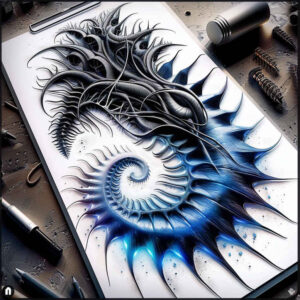
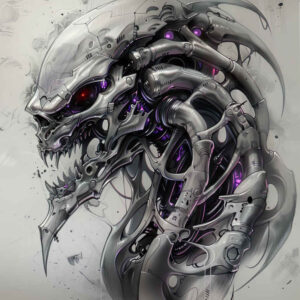
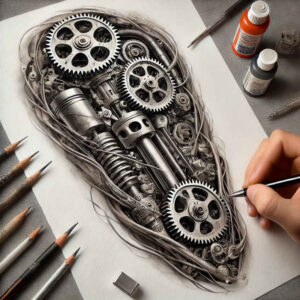
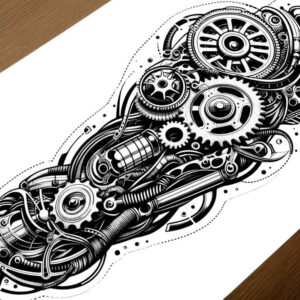
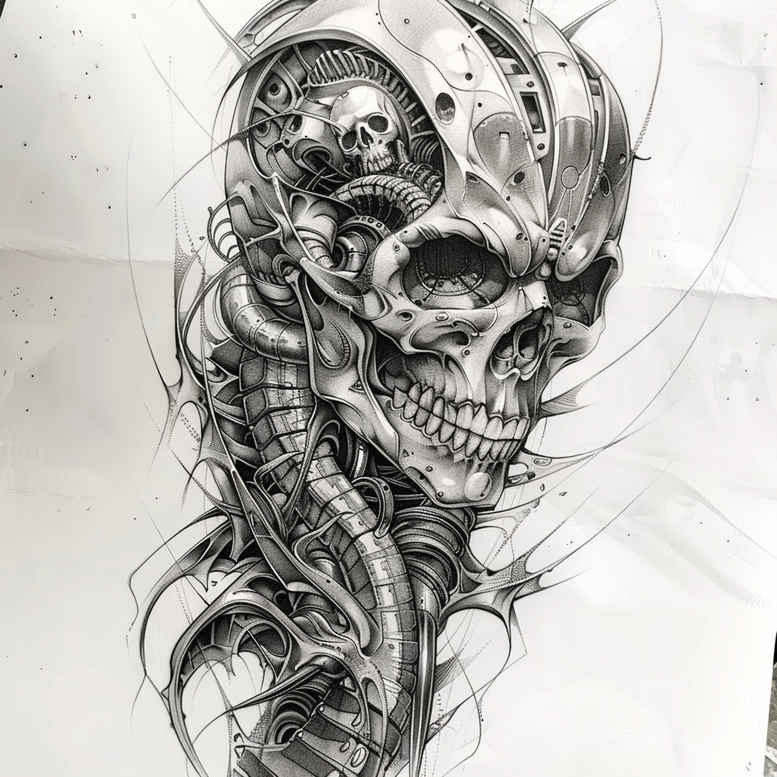
AI-generated tattoo project concept realized as a bold, cover-up friendly skull motif fused with mechanical gear and wire elements. Executed in black and grey with dense linework and subtle shading to achieve depth and texture. The central image is a stylized skull whose cranium blends into torqued gears, tubing, and metallic plates, creating a biomechanical silhouette that reads as both skull and machine. The design emphasizes graphic patterns through repeating circular gears, cross-hatching, and serpentine wiring that weave around the bone structure, lending an intricate pattern that stays legible as a tattoo design even on larger canvases. The composition guides the eye along the spine of the figure, with the jaw and cheekbone forming negative space that balances light and shadow. Technique-wise, fine line precision, stippling, and smooth black and grey gradients build contrast and a three-dimensional feel while preserving a crisp silhouette for aging skin. Symbolically, the skull represents mortality and resilience, while the mechanical elements signify resilience through industry and transformation—an apt metaphor for personal evolution. In terms of tattoo design categories, this piece sits at the intersection of black and grey realism and biomechanical style, suitable for dedicated study as a meaningful tattoo with potential for small tattoos or larger sleeves depending on placement. If used as a cover-up, the dark ink density and graphic density can effectively obscure prior tattoo work, channeling attention to the new composition. The piece can be adapted to Japanese style tattoo motifs or translated into a more traditional tribal or lotus-flower-inspired motif if requested, but the current design emphasizes a modern, high-contrast biomechanical look. The result is a striking, moody body art concept that leverages ink density, line weight, and pattern to deliver a compelling, durable tattoo that ages gracefully, while offering versatility for future customization. This description notes the AI origin as a conceptual tattoo project, and the design can be refined for a finalized commission. For tattoo shops, this concept translates well to adapted sizes from small forearm pieces to full back panels, with careful mapping of dark shading to preserve readability as age.