Description
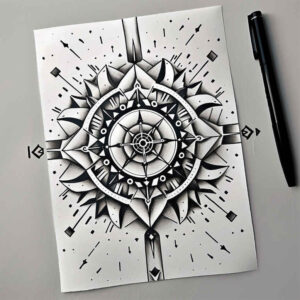
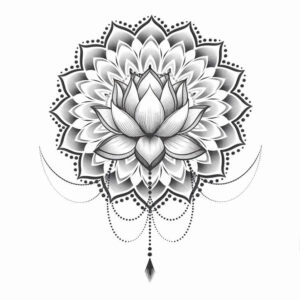
This AI-generated tattoo project presents a dark, highly detailed geometric mandala pattern anchored by a concentric floral core. Executed in black and grey, the design blends dense linework with rich shading gradients to create a striking balance between negative space and solid ink. The central mandala reads as a lotus-inspired flower at its heart, radiating outward with layered petals and a network of triangular motifs that taper into elongated downward pendants. The overall composition is crisp and symmetrical, with fine lines that hold their edge when scaled and shading that reads as a continuous gradient from inky blacks to softer charcoal tones. The geometry is deliberately intricate, featuring polygonal facets, radial spears, and notch-like separators that echo traditional Japanese style tattoo motifs while remaining adaptable to tribal or modern geometric interpretations. In terms of meaning, mandala symbolism evokes balance and wholeness, while the flower elements suggest growth, renewal, and beauty; together they form a meaningful tattoo concept suitable for high-visibility placements or concealed cover-ups depending on palette and size. The piece is designed as a versatile tattoo design; it can be rendered as a standalone black and grey work or extended into a larger sleeve with additional Japanese-inspired waves or dot-work textures. Because of its dense ink coverage and layered patterning, this design is particularly well-suited as a cover-up, effectively masking older ink beneath a cohesive, striking surface. As an AI-generated tattoo project, it demonstrates the potential of digital composition to inform traditional craft, offering a robust template for custom tattoo design, small tattoo accents, or more expansive body art projects. By adjusting line weight, shading, and motif density, it can adapt to lotus flower symbolism, infinity tattoo themes, tribal tattoo silhouettes, or classic rose tattoo design cues, delivering a timeless option for clients seeking bold black and grey ink. The motif’s symmetry and the interplay of sharp edges with soft shading invite exploration in a variety of body canvases, from forearms to backs, and its pattern-driven structure provides a durable framework for color overlays or texture additions while maintaining legibility as the scale shifts across placements.