Description
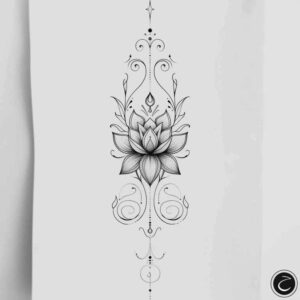
This magnum study presents a fine line mandala tattoo design pattern drawn in black and grey ink on a white sketch sheet. The centerpiece is a lotus bloom, framed by radiating petals and a lattice of geometric motifs that cascade along a vertical axis, yielding a motif that feels both floral and mandala-inspired body art. The execution relies on ultra-precise linework, consistent needle angles, and deliberate negative space to maintain legibility when scaled to small tattoos or extended into larger placements such as the forearm, sleeve, or back. As a tattoo project idea, the pattern is deliberately adaptable, inviting adjustments in size, line weight, and spacing while preserving the clarity of the motif. Symbolically, the lotus stands for purity and awakening, while the surrounding geometry conveys balance, cycles, and infinity—ideas popular in meaningful tattoos and well-suited to a custom tattoo design approach. The piece demonstrates how a pattern-driven composition can function across multiple genres, from flower tattoos to more intricate infinite or tribal interpretations, and even a Japanese style tattoo variant if desired, all while remaining a strong black and grey option for ink on skin. From a practical perspective, this study highlights the feasibility of small tattoos featuring a lotus motif or a larger, nuanced graphic that relies on fine line tattoo techniques, dotwork, and restrained shading to create depth without overpowering the design. The design can function as a template for a variety of body art projects, including rose tattoo design options and other flower tattoos, and it serves as a prime example of a custom tattoo design approach suitable for ink and for those seeking a bold yet refined look. As an AI-generated tattoo project, it demonstrates how algorithmic creativity can inform clients seeking clean, repeatable motifs and versatile body art concepts, including options for Japanese style tattoo, tribal tattoo, or realistic black and grey renditions, all anchored by a crisp linework aesthetic. With careful placement considerations, the vertical axis supports alignment along the spine, ribcage, or leg and can be simplified to a single column or extended into a full sleeve, while preserving the balance of negative space and ink density.