Description
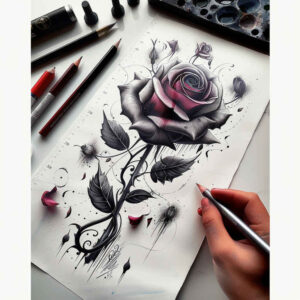
An AI-generated tattoo project concept portraying a single purple rose rendered with fine-line precision, leaves, and a curling stem. The artwork reads as a delicate botanical study suited for a small tattoo or as the focal element of a larger piece. The rose’s petals curl with subtle gradation and crisp line work, while light shading provides depth without sacrificing legibility on skin. The drawing is presented on a sheet of paper, with a hand guiding the composition, a pen, and a bottle of ink nearby, signaling its origin as a sketch-to-tattoo idea intended for adaptation by a practicing artist. The color choice—lavender and violet hues with cool gray accents—offers a romantic mood while preserving readability in both color and monochrome ink passes, enabling a flexible transition toward black-and-grey or saturated color work. The concept explores how botanical motifs can convey meaning: growth, resilience, and beauty, with the rose symbolizing love and transformation, the leaves representing nourishment and balance, and the stem hinting at perseverance. The AI-generated origin is acknowledged to reflect contemporary design pipelines and the evolving role of machine-assisted concept generation in tattoo art, while the hand-drawn texture invites a human touch to refine line weight, shading gradients, and placement. For practitioners and clients, this piece serves as a precise study in fine-line tattoo technique, suitable as a small tattoo for discrete placements such as the wrist, ankle, behind the ear, or as a custom tattoo design to accompany other motifs. It also functions as a meaningful tattoo concept for those drawn to flower tattoos or rose tattoo designs, and can be reinterpreted in Japanese-style or realistic tattoo idioms while preserving botanical accuracy. Artists can deploy this sketch as a base for ink tests, translate it into a full-color sleeve motif, or adapt it to a black-and-grey palette to suit conservative skin tones; in any case the composition honors the timeless appeal of roses in body art and demonstrates how a simple floral form can carry rich symbolism and personal narrative.