Description
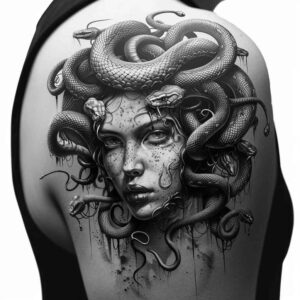
An intricately rendered black-and-grey portrait study, this design centers a female face framed by voluminous, swirling hair. Rendered in a refined fine line tattoo technique, the piece emphasizes subtle gradations of tone to convey depth and realism while preserving a delicate, almost ethereal quality. The hair coils into sinuous loops that weave around the contours of the face, creating a rhythm of negative space and tonal shading that reads both as lace-like texture and dramatic silhouette. The artist uses controlled line weight, stippling, and soft gradient shading to achieve a cohesive composition suited to a forearm, back, or calf canvas, typical of contemporary tattoo design traditions. Though monochrome, the piece relies on light-to-dark transitions to model features: the brow line, the arc of the cheek, the shape of the lips, and the gaze. The pattern-like hairwork provides a rich interplay of motion and restraint, giving the design a sense of movement without sacrificing legibility. From a symbolic standpoint, the portrait evokes themes of inner harmony, resilience, and the balance between light and shadow; the monochromatic palette reinforces a timeless, versatile aesthetic compatible with many tattoo genres, including black and grey, fine line, and realism. For meaningful tattoos, this concept pairs well with floral motifs such as lotus flower tattoo or rose tattoo design, as well as small tattoos and flower tattoos for a subtle, personal statement. It also holds potential for a custom tattoo design that nods to Japanese style tattoo through disciplined line work, while remaining adaptable to Western realism sensibilities. The artwork invites layering—a delicate bloom behind the ear, geometric accents along the shoulder, or soft waves that translate into a cohesive sleeve. Designed with ink, it demonstrates how a portrait can honor identity and memory while offering versatility for future modifications, ensuring each line, curve, and shadow contributes to a timeless body art piece. Techniques described include line-weight variation to separate facial planes, dot shading for texture, and smooth transitions to avoid harsh borders when applied to delicate skin. The design reads well in black and grey, and the absence of color emphasizes form, light, and shadow rather than pigment, aligning with fine line tattoo and realistic tattoo traditions while remaining easily adaptable to a variety of placements.