Description
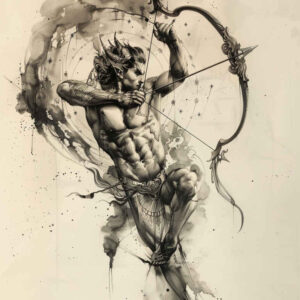
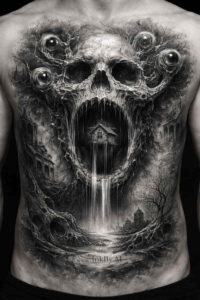
This tattoo design presents a dominant ram head with curling horns, rendered in black and grey with meticulous shading to create depth and texture. The composition combines naturalistic anatomy with geometric ornamentation: circular rings, intersecting lines, orbs, and fine line grids weave around the head, forming a dynamic halo of structure that anchors the piece. The ram’s gaze is steady, the beard rendered with subtle feathering to imply fur without saturating the palette. The shading transitions from solid blacks to soft grayscale, enabling smooth gradients that will age well on the skin. The geometric pattern acts as both frame and motif, offering negative space around key elements and providing opportunities for bold scale adjustments, which makes this design particularly suitable for cover-up scenarios where darker areas can be extended to mask underlying tattoos. The piece emphasizes contrast and balance between organic form and precise geometry, ideal for someone seeking a meaningful tattoo that nods to strength and resilience while remaining versatile across body placements. The motifs suggest a fusion of animal symbolism with modern tattoo design vocabulary: the ram symbolizes determination and endurance; the circle and orbit shapes imply cycles and infinity, while the fine lines create a sense of motion and rhythm. In terms of style, the piece leans toward black and grey realism with a strong emphasis on negative space and line work; it embodies the classic tattoo design approach while embracing contemporary geometric patterns that can be adapted for a range of sizes. This project is a tattoo concept suitable for those seeking small to large coverage options; the bold central ram can anchor a sleeve, chest, or back piece, with the circular motifs serving as an adaptable scaffold. Note that this is an AI-generated tattoo project and, given its dark palette, can be executed as a cover-up, allowing the surrounding skin to merge with the design while preserving detail in the ram’s features and the geometric framework. The design also showcases possibilities for pattern-based shading and line work that can be expanded to larger surfaces, maintaining cohesiveness across scales.