Description
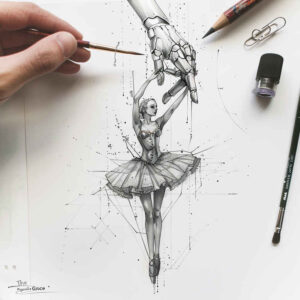
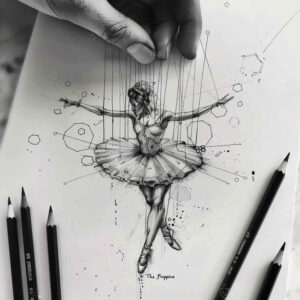
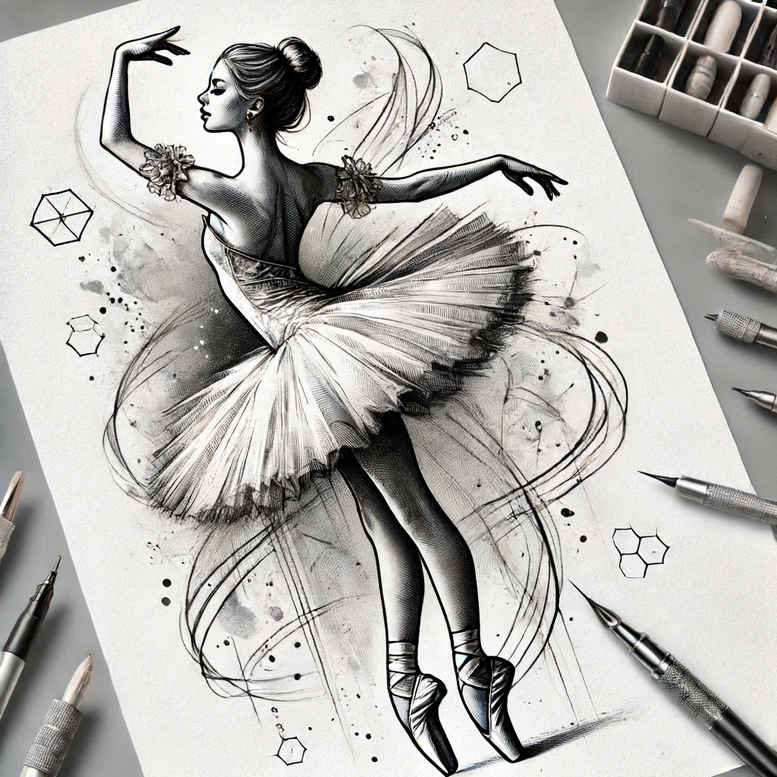
This is an AI-generated tattoo project concept that explores motion, grace, and geometric rhythm fused into a single image. The central figure is a ballerina rendered in black and grey, captured en pointe with a full tutu, her form defined by precise fine-line strokes and subtle shading that preserve clarity on skin. Surrounding her is a graphic pattern of circles and orbital lines that weave through the composition, imparting a sense of momentum while keeping the silhouette legible as a tattoo. The technique emphasizes clean, delicate line work, restrained contrast, and intentional negative space to ensure readability at both small and large scales. Symbolically, the dancer embodies discipline, resilience, and the pursuit of beauty; the tutu provides a soft, airy counterpoint to the geometric pattern, which introduces a contemporary edge. From a design perspective, the concept blends classical ballet imagery with modern patterning, offering versatility for placement on the forearm, calf, or back and compatibility with various styles, including fine line and black-and-grey realism. This concept serves as a meaningful tattoo design for fans of graceful movement, small tattoos, and flower or geometric motifs, with potential adaptations into Japanese-style tattoos or more intricate black-and-grey compositions. It foregrounds keyword-rich anchors such as tattoo, tattoo design, meaningful tattoos, fine line tattoo, black and grey, realistic tattoo, body art, and ink, while also allowing for expansion into related ideas like lotus flower tattoo, infinity tattoo, or rose tattoo design through future iterations. As an AI-generated tattoo project concept, it invites artists and clients to explore how motion and pattern can translate into wearable body art that stands the test of time. Design refinements emphasize scalability and personalization, enabling a custom tattoo design that respects individual anatomy and tone. Artists can adjust line density, shift pattern weight, or introduce subtle shading to match client skin tone, while preserving the dancer’s silhouette. In printing and ink studies, the pattern reads as an abstract musical score, aligning with themes of movement, time, and artistry.