Description
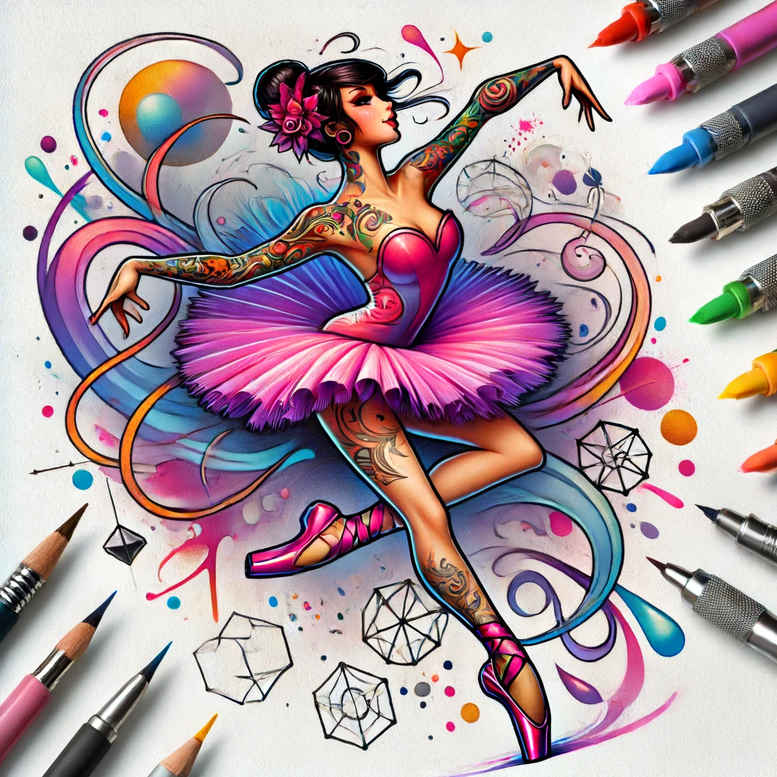
This is an AI-generated tattoo project concept featuring a vibrant ballerina adorned with a pink tutu, flowing ribbons, and intricate geometric patterns. Rendered in vivid full color, the design blends a dynamic illustration style with crisp linework and layered shading to create a live, wearable tattoo design concept for a commission or personal project. The central figure is a dancer caught in mid-turn, her tutu flaring as ribbons swirl around her limbs, forming a tapestry of curves that guides the eye through the frame. Surrounding her are geometric shapes and tessellated facets that introduce a contemporary pattern motif without overpowering the figure. The color palette emphasizes pinks, purples, teals, and skin tones, anchored by strong black outlines that hold the image as a tattoo design. This concept suits a range of applications, from small floral-inspired pieces to larger back or thigh compositions, and it leans toward a Japanese style with clean linework, balanced negative space, and a sense of movement that translates well into a fine line or colorful tattoo. While the imagery nods to flower motifs such as lotus and rose tattoos, the composition remains flexible enough for a realistic or black and grey variant should a client request a subdued look. The geometric elements also offer a pattern-driven approach that can be scaled and rearranged to fit different body contours, and the symbolism of growth and metamorphosis echoes the themes often chosen in meaningful tattoos. As an AI-generated tattoo project concept, this piece demonstrates how inventive narrative imagery can be harmonized with technical tattoo considerations, including ink flow, skin tone adaptability, and line density, ensuring it reads clearly on skin as a bold yet elegant body art statement. From a practical standpoint, the design supports variations such as a minimal fine line version focusing on the silhouette of the dancer and ribbons, or a gradient wash that breathes color into the graphic lines. The integration of geometry with organic motion challenges the tattoo artist to balance high-contrast edges with softer color transitions, a test of skill for any dedicated studio. For those seeking an ink piece with depth, the concept invites additional shading, stippling, and shadow work to achieve a realistic tattoo or a more graphic, stylized interpretation depending on preference.